

Looking for a reliable hair clipper manufacturer in China? Learn how to evaluate factories, compare OEM suppliers, verify engineering capability, and avoid costly sourcing mistakes.
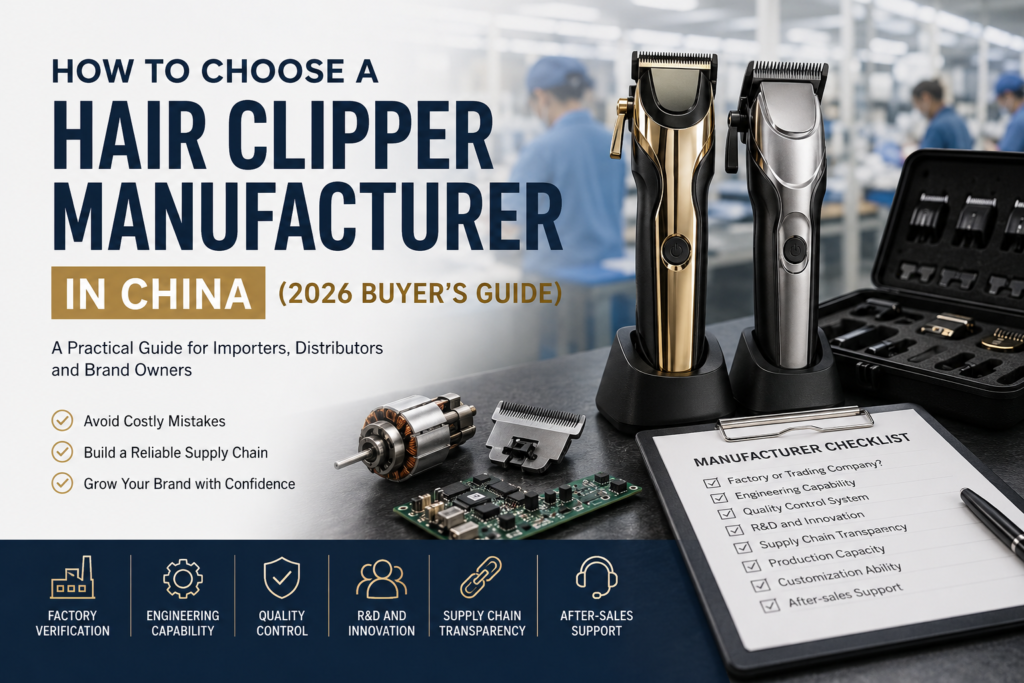
One importer from Europe once told me, “We’ve already changed suppliers three times in two years, but we’re still struggling with warranty issues.” Ironically, every supplier claimed they were a professional manufacturer. I’d like to say yes a true manufacturer is important for your product and brand development, but still there are many difference between factories.
Introduction: The Hair Clipper Manufacturing Paradox
For over two decades, China has been the undisputed heart of the global hair clipper industry. From high-end professional tools used in New York barbershops to affordable home grooming kits in European supermarkets, there is a 90% chance the device was born in a Chinese factory.
However, as we move into 2026, the landscape has shifted. The “Copy-Paste” era is over. Today’s market demands high-torque brushless motors, 4-hour battery life, DLC (Diamond-Like Carbon) coated blades, and ergonomic designs that prevent carpal tunnel syndrome.
If you search for “Hair clipper manufacturer China” on any B2B platform, you will be hit with over 5,000 results. But here is the industry secret: Less than 5% of these “suppliers” are actual professional hair clipper factories with independent R&D capabilities. Most are trading companies or general electronics assemblers who treat hair clippers like just another plastic gadget.
Choosing the wrong partner doesn’t just mean losing money; it means high warranty return rates, negative Amazon reviews, and permanent damage to your brand’s reputation.
This guide is not a list of “Top 10 Factories.” Instead, it is a masterclass in how to evaluate, audit, and partner with a specialized clipper manufacturer that can actually grow your business.
Why China Is (Still) the Global Manufacturing Hub for Hair Clippers
Before we dive into the “How,” we must understand the “Why.” Why shouldn’t you manufacture in Vietnam, India, or Mexico? It comes down to the Industrial Cluster Effect.
In the hair clipper world, a finished product is only as good as its weakest component. To build a world-class clipper, you need:
- High-Precision Blade Suppliers: Specialized in heat treatment and grinding techniques.
- Motor Engineering Hubs: Factories that can customize RPM and torque for specific hair types.
- Battery Management Systems (BMS): Suppliers providing stable Li-ion or LiFePO4 cells.
- Tooling and Injection Molding: High-quality ABS and metal housing capabilities.
Within the manufacturing hubs of Zhejiang and Guangdong, these suppliers are often within a 2-hour drive of each other. This proximity allows for rapid prototyping and strict quality synchronization.
Veteran’s Note: “The supply chain is accessible to everyone, but the ability to integrate it is rare. A mediocre factory buys a motor and puts it in a shell. A engineering-driven manufacturer works with the motor supplier to optimize the magnetic flux for lower noise and higher efficiency.”
1. Factory or Trading Company

The first step in your journey is identifying who you are actually talking to. In China, many trading companies (middlemen) are masters of disguise. They use the same professional photos and claim they are “The Factory.”
Why it matters:
- Quality Control: A trader cannot control the assembly line.
- Technical Support: If a blade gets too hot after 5 minutes, a trader won’t know why. A factory engineer will check the blade friction and the motor’s power output.
- Cost Transparency: You are paying a 10-20% “middleman tax” that could have gone into better components.
How to verify:
- Check the Business License: Look for “Manufacturing” (生产/制造) in their scope of business.
- Request a Live Virtual Tour: Ask to see the Assembly Line and the Testing Room immediately on a video call. If they say “the factory is in another city,” they are likely a trader.
- The “Third-Party Audit” Test: Tell them you want to send an auditor (like SGS or Intertek) next week. Traders often hesitate or try to redirect you.
- A trading company can usually answer questions about price, packaging and shipping. But once the conversation turns to blade hardness, PCB programming, motor matching or heat dissipation, they often need to “check with the factory.”
- If a compnay sells hair clipper, hair trimmers, and sells flat irons, curling irons, hair dryers the same time. Probably they are a trader at least.
Industry Secret
Many buyers compare motor speed by looking at RPM. Professional engineers will not. Two clippers can both advertise 8,000 RPM. Yet one feels powerful while the other constantly pulls hair.
That’s because cutting performance also depends on: Torque output/ PCB programming/ Blade pressure/ Gear precision/ Lubrication/ Blade geometry. RPM is simply the easiest specification to print on a brochure. It’s far from the most important.
2. Engineering Capability
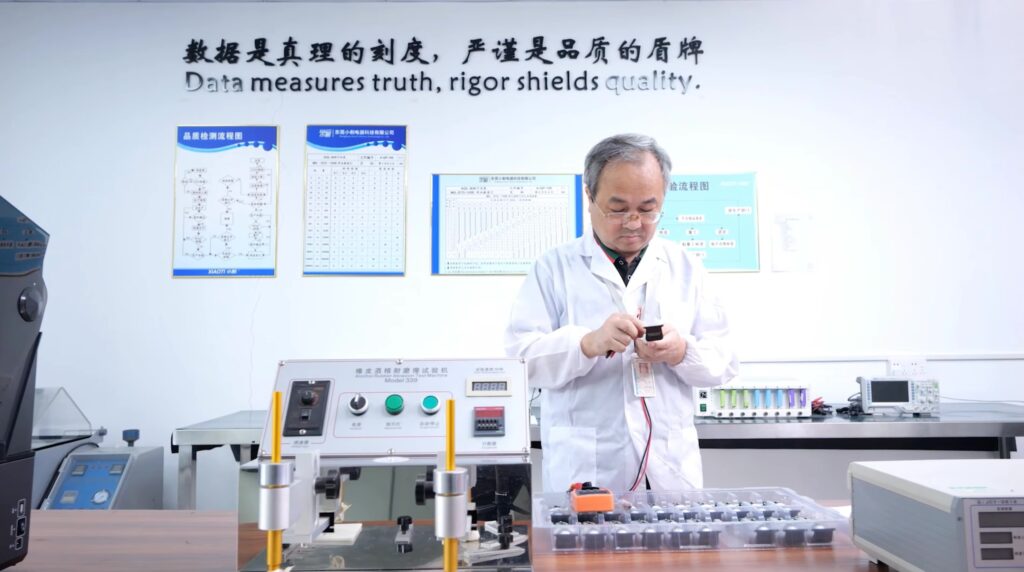
In 2026, a hair clipper is no longer a simple mechanical tool; it is a piece of precision electronics. You must look for a experienced engineering-driven manufacturer that understands the physics of cutting hair.
The Technical Litmus Test:
- Motor Matching: Does the manufacturer understand the difference between a Vector, BLDC, Magnetic, and DC motor? Can they explain why they chose a specific RPM for a “Fading” clipper vs. a “Bulk Removal” clipper?
- Blade Geometry: Ask them about the “Crush” factor. A professional factory will talk about the distance between the moving and cutting blade, the sharpening angle, and the coating (Titanium, Ceramic, or DLC).
- Heat Management: Hair clippers generate friction. A high-quality manufacturer designs the blade and housing to dissipate heat, ensuring the tool stays cool for a 45-minute haircut.
- Vibration and Noise: True engineering capability is shown in how they dampen vibration. Ask for decibel (dB) ratings under load, not just idle.
3. The R&D Team
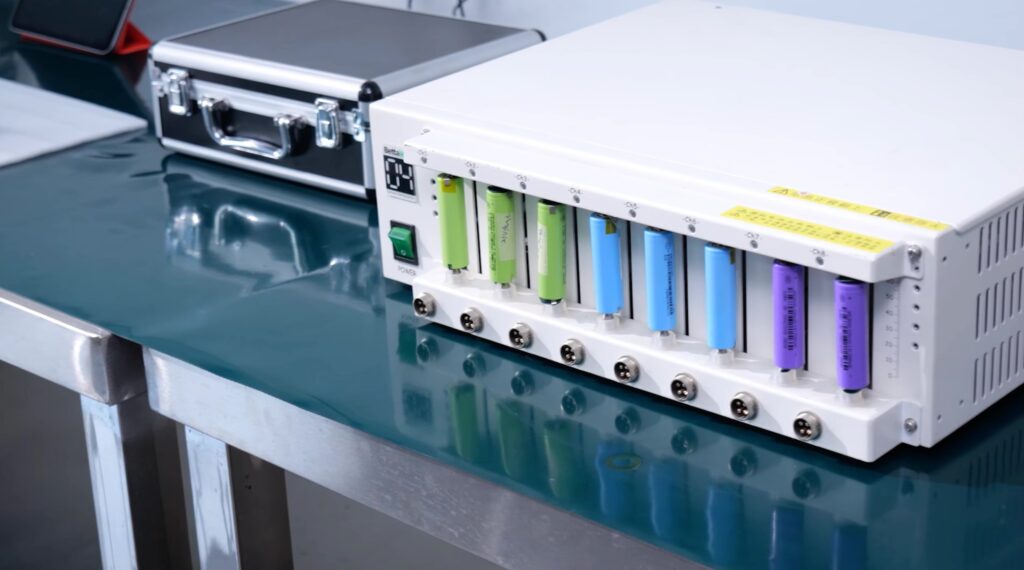
Don’t ask “Do you have engineers?” Instead, ask:
- “How many patents do you hold for original designs?”
- “Can you provide a 3D mold drawing for a custom housing in 10 days?”
- “Do you design your own PCB (Printed Circuit Board)?”
A top-tier China hair clipper factory will have an R&D department that includes industrial designers, mechanical engineers, and electrical engineers. They should be able to help you reduce warranty rates by optimizing the internal layout to prevent hair from clogging the motor.
4. Production Capacity and Infrastructure
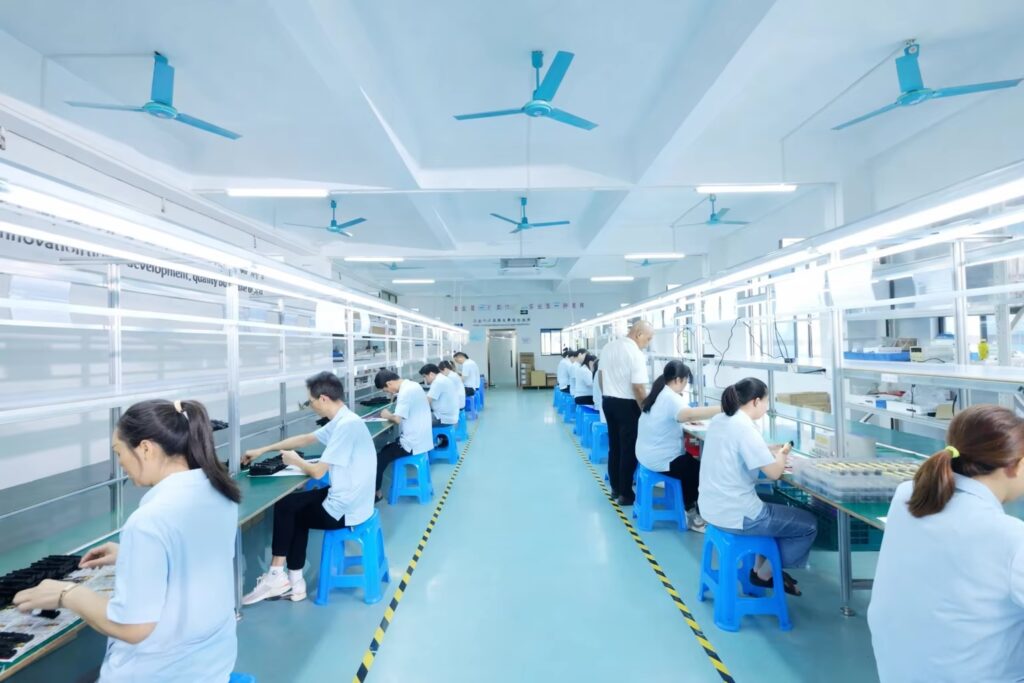
Scale matters. If you are an importer or a large-scale distributor, you need to ensure the factory won’t buckle under your orders during peak seasons.
Look for:
- Injection Workshop: Owning their own molding machines means better control over the “fit and finish” of the plastic parts.
- Clean Assembly Lines: Dust is the enemy of motors and PCBs.
- Monthly Output: Can they handle 50,000 units? 100,000 units? But of course, if they’re organized, and you can provide them stable order, it’s just a matter of time to adapt by putting more assembly line and workers.
- Warehouse Standards: Are the finished goods stored in a dry, organized environment?
5. Quality Control
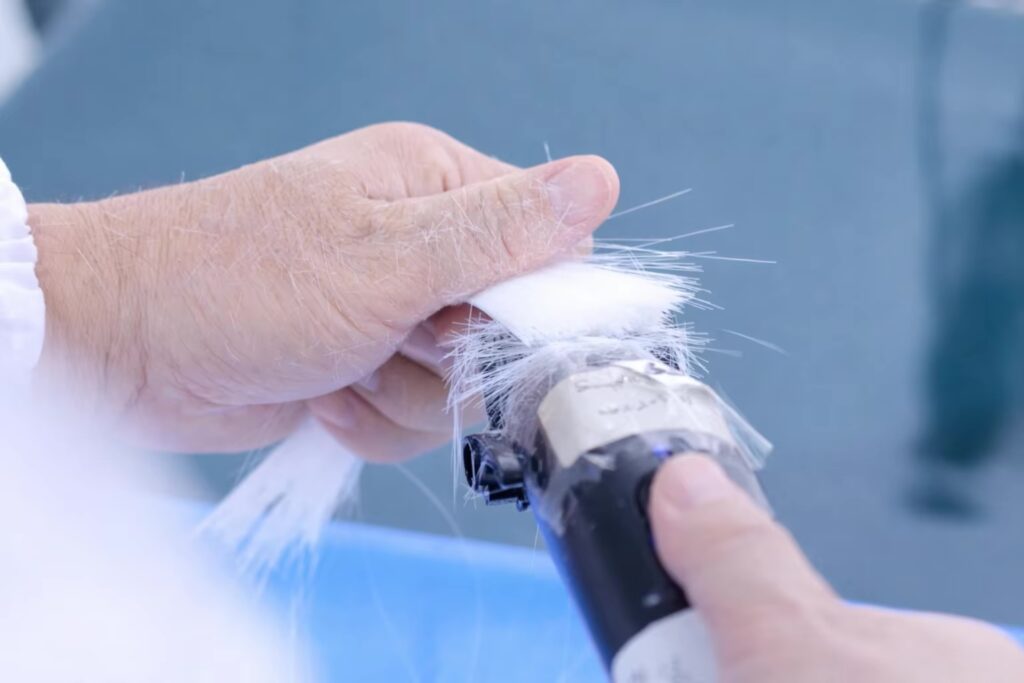
Price is what you pay; QC is what you get. A hair clipper OEM manufacturer might offer you a $12 clipper, but if 5% of the batteries fail after 3 months, your brand is dead.
The Mandatory QC Checklist:
- IQC (Incoming Quality Control): Testing every batch of motors and batteries before they enter the line.
- IPQC (In-Process Quality Control): Checking the torque and noise of the motor after it’s mounted in the frame.
- Life Test (The Aging Room): Does the factory run samples for 500+ hours to see when they fail?
- Drop Test: Professional clippers are dropped in barbershops. Do they survive a 1.5-meter fall onto concrete?
- Blade Salt Spray Test: To ensure the blades won’t rust in humid bathroom environments.
- Noise and blade Inspection: Every single clipper should be turned on, tested for noise, and checked for blade alignment.
- 100% Final Inspection: Every clipper need to run at least one whole recycle to make sure Safety, Performance, Reliability before being packed.
6. The Price Trap: Why “Cheap” Is Expensive
I’ve met buyers who switched suppliers simply to save US$1.50-$2 per unit. Months later, many of them told me the same thing: “The cheaper quotation became the most expensive decision.”
Imagine you’ve already invested:
- Packaging
- Marketing
- Amazon Listing
- Inventory
Then one battery issue destroys hundreds of reviews. Suddenly, saving US$1.50-$2 doesn’t seem like a bargain anymore.
The “Cheap” Reality:
- Recycled Plastic: Brittle and cracks easily.
- Generic Motors: Fluctuating speeds that pull hair.
- Low-Grade Batteries: Capacity drops by 50% after 20 charges or even catches on fire (there was news in year 2023,and brand called back on June 20th, 2024).
- Poor QC: You become the factory’s QC department, dealing with angry customers.
Instead of looking for the lowest price, look for the best ROI. A $15 professional clipper that lasts 3 years is a much better investment for your brand than a $10 clipper that fails in 6 months.
7. Why Good Samples Don’t Always Mean Good Mass Production
Many brands experienced with this. It’s not a QC matter, in fact, factory may change these components for better condition: Motor, PCB , Battery, Blades, even Grease’s cost is largely different between a premium and a poor hair clipper.
A customer once switched suppliers because another factory quoted US$1.60 lower.
Six months later, their Amazon return rate nearly doubled.
After investigation, the supplier had quietly replaced the original battery with a lower-cost alternative.
8. Supply Chain
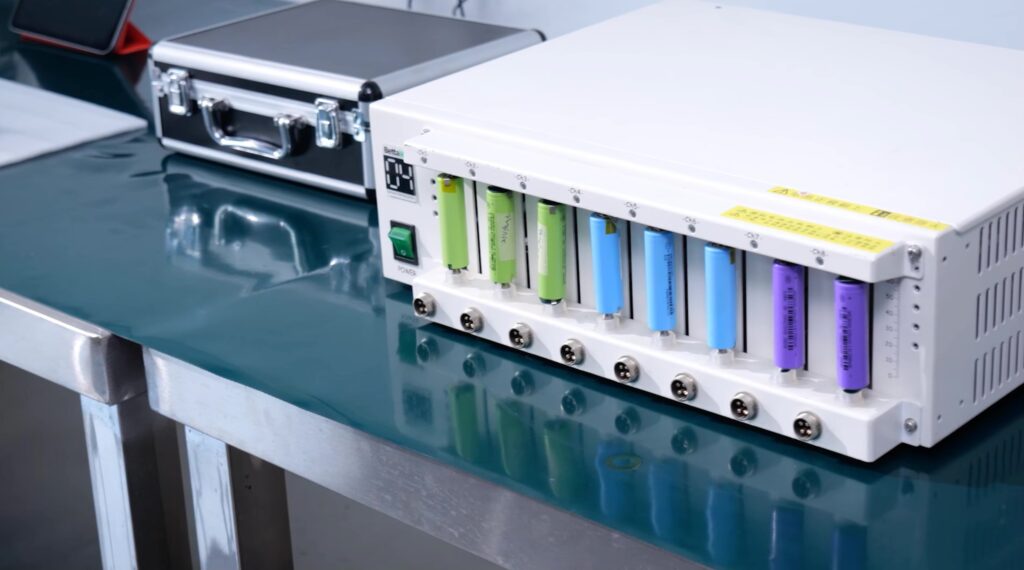
A product development partner is like an orchestra conductor. They don’t make the violin, but they must choose the best violinist.
Ask your potential supplier:
- “Who is your battery cell provider?” (Look for brands like Highstar or reputable Li-ion producers).
- “Where do you source your steel for blades?” (Japanese 440C or high-carbon German steel are the gold standards).
- “What grade of PCB components do you use?”
Maybe some factory doesn’t want to provide a exact name but they would like to let you know the difference. A factory provices quality should be proud of its supply chain.
9. Customization (ODM/OEM) Capability
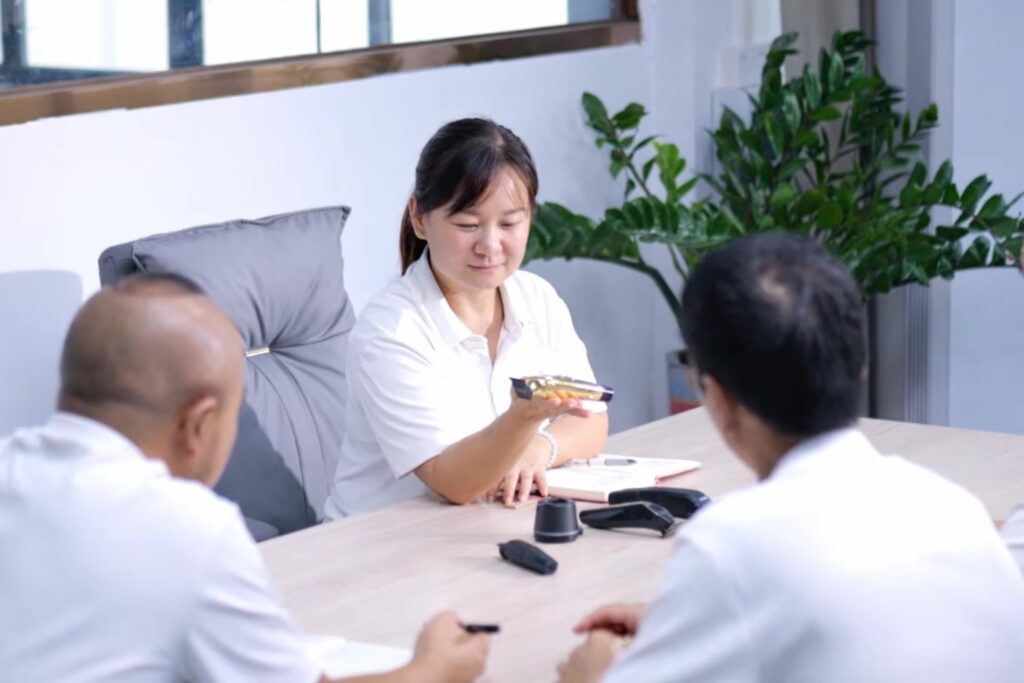
Most brands want more than just a logo on a generic body. If you want a Private label hair clipper that stands out on Amazon or in a barber supply shop, you need customization depth.
Levels of Customization:
- Basic OEM: Logo printing, customized color, and packaging.
- Advanced OEM: Changing the blade type (e.g., from a T-blade to a Fade blade), upgrading battery capacity.
- Full ODM: Designing a completely new design- mold, unique motor specs, and proprietary features (like LED displays or custom charging docks).
A true partner will provide you with Tech Packs and Prototyping before the final mold is opened.
10. Factory Audits (Physical or Virtual)
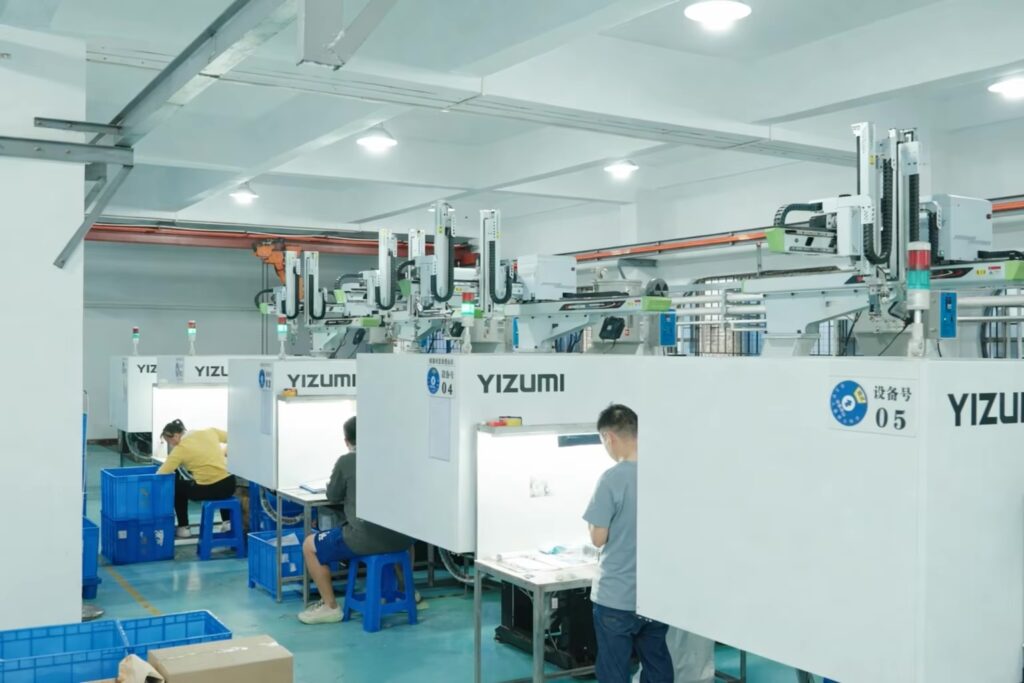
Never place a large order without seeing the operation.
- Physical Visit: If possible, visit the factory in Ningbo or Dongguan. Watch the workers. Are they rushed and sloppy, or methodical and precise?
- Virtual Audit: Request a walkthrough of the Testing Lab. Ask to see the motor life-testing machine in action. A professional factory will be happy to show off its precision equipment.
11. Bigger Doesn’t Always Mean Better
Some buyers automatically assume that the largest factory must produce the best clippers.
In reality, we’ve visited factories with more than 1,000 employees that simply assemble standard products from existing molds.
Meanwhile, smaller engineering-driven manufacturers are often responsible for developing some of the industry’s most innovative professional clippers.
12. Long-Term Partnership
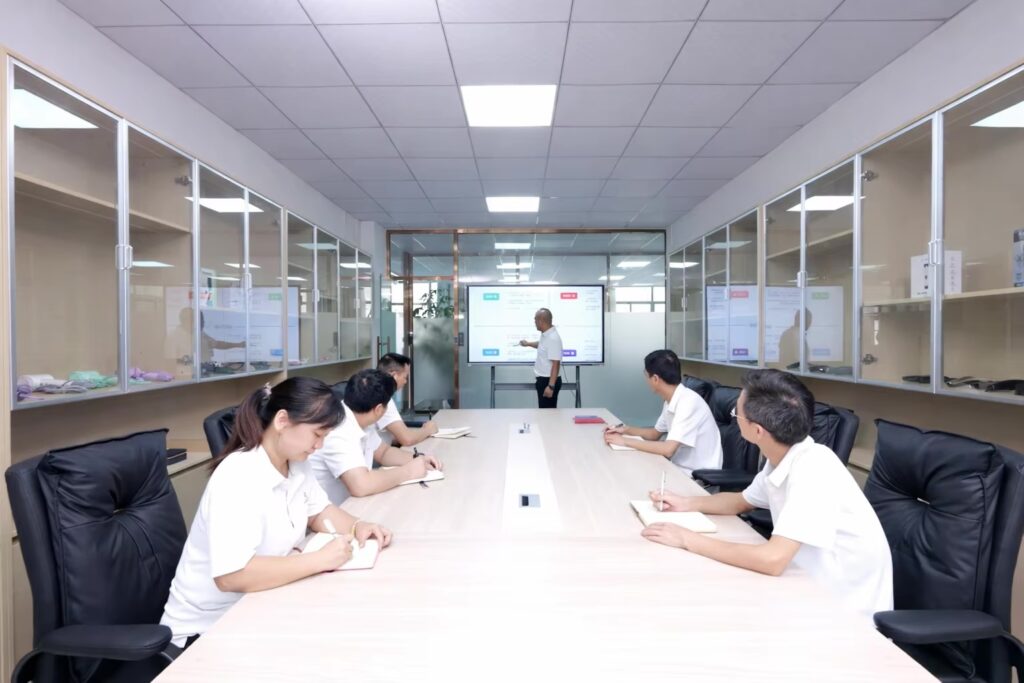
The best hair clipper supplier in China isn’t just a vendor; they are your “External Engineering Department.”
A good partner will:
- Proactively suggest improvements: “We noticed your battery cover is a bit loose; let’s tweak the mold.”
- Share market trends: “We are seeing a move toward USB-C charging for all pro models.”
- Protect your IP: They won’t sell your custom design to your competitors.
Common Mistakes Buyers Make (And How to Avoid Them)
To help you stay ahead, here are the most frequent pitfalls we’ve seen over the last 20 years:
- Selecting the Lowest Bidder: This is the #1 reason for brand failure.
- Skipping the Sample Phase: Never order mass production without testing “Golden Samples” for at least two weeks.
- Assuming “CE/RoHS” Means Quality: These are safety and environmental certifications, not performance indicators. A clipper can be “safe” but still cut hair poorly.
- Ignoring Communication Speed: If a supplier takes 3 days to answer a technical question now, imagine how slow they will be when you have a quality crisis.
- Working with Non-Specialists: Avoid factories that make “everything.” If they make hair dryers, shavers, massagers, and clippers, they aren’t experts in any of them. Choose a factory that focuses on clippers.
Checklist Before Choosing a Hair Clipper Manufacturer
Use this checklist during your next meeting with a potential supplier:
| Evaluation Criteria | Yes / No | Veteran’s Tip |
|---|---|---|
| Is it a real factory? | [ ] | Check business license and assembly lines. |
| Do they have an in-house R&D team? | [ ] | Ask for 3D design capabilities. |
| Is there a dedicated QC/Testing lab? | [ ] | Look for aging and drop test machines. |
| What is the motor source? | [ ] | Ensure stable RPM and high torque. |
| What is the blade material? | [ ] | Look for High-Carbon Steel or DLC coatings. |
| Can they handle full ODM? | [ ] | Ask for previous custom mold examples. |
| Do they have export experience? | [ ] | Ensure they understand US/EU voltage and safety standards. |
| Is the communication clear? | [ ] | Test their technical English or understanding of your specs. |
The importance of each evaluation item
| Evaluation Item | Weight |
|---|---|
| Engineering | ⭐⭐⭐⭐⭐ |
| QC | ⭐⭐⭐⭐⭐ |
| Factory | ⭐⭐⭐⭐ |
| R&D | ⭐⭐⭐⭐⭐ |
| Supply Chain | ⭐⭐⭐⭐⭐ |
| Price | ⭐⭐ |
FAQ: Sourcing Hair Clippers from China
Q: Where are the best hair clipper factories located?
A: Most are clustered in Ningbo/Wenzhou (Zhejiang province) and Dongguan/Shenzhen (Guangdong province). Zhejiang is often better for mass-market value, while Guangdong often excels in high-end electronics and professional gear.
Q: What is the standard MOQ for private label clippers?
A: For logo printing on existing models, it’s usually 500-1,000 units. For custom molds (ODM), it can be 3,000-5,000 units due to the cost of tooling.
Q: How do I handle warranty and returns from overseas?
A: A reliable China hair clipper factory will provide a 1-2% “spare parts” allowance or extra units with every order to cover potential defects.
Q: Are Chinese blades as good as Japanese ones?
A: Yes, if you choose the right grade. Top Chinese manufacturers source premium steel and use high-tech grinding machines that rival any global brand.
Conclusion: Your Brand Deserves a Real Manufacturer
Choosing a hair clipper manufacturer in China is one of the most significant decisions you will make for your brand. In an industry where precision and reliability are everything, you cannot afford to work with a middleman or a low-end assembler.
A professional manufacturing partner will not only provide you with a product but will also provide the peace of mind that allows you to focus on marketing and growth. They will help you reduce warranty issues, accelerate your time-to-market, and ultimately build a reputation for quality.
If you are planning to launch a professional hair clipper or a private label grooming brand, invest the time to audit your factory properly. Look beyond the price tag, look into the engineering, and build a partnership that lasts.
Questions Every Buyer Should Ask Before Signing a PO
1. Who designed this clipper?
2. Who owns the mold?
3. Can I buy spare parts after 3 years?
4. What happens if a motor supplier stops production?
5. Can I meet your engineer?
6. How do you validate a new supplier?
7. Can I audit your QC process?
8. Can you provide batch traceability?
Final Thoughts From the Author
After spending years working with professional barber brands and product development teams, I’ve learned one simple lesson:
The best manufacturer isn’t the one that promises the most. It’s the one that solves problems before your customers ever notice them. Whether you’re sourcing your first clipper or developing the next flagship model for your brand, remember this:
You’re not choosing a supplier. You’re choosing the company that will quietly protect your reputation every time a customer picks up your product.
Every clipper looks similar inside a product catalog. The real difference only becomes visible after thousands of haircuts. That’s why choosing a manufacturer isn’t about today’s quotation.It’s about tomorrow’s reputation. Because every satisfied barber is quietly advertising your brand. And every defective clipper is doing exactly the opposite.
Choose wisely.
About the Author
Holley is a Co-Founder at XIAOTI, specializing in OEM and ODM hair clipper development. After working with barber brands, distributors, and importers across North America, Europe, and Australia, she shares practical sourcing insights to help brands build better grooming products.