

A good sample does not always mean stable mass production.
For professional hair clippers, many quality problems only appear after repeated use in a real barbershop. A clipper may look good during the first test, but later develop weak cutting power, blade pulling, charging failure, excessive noise, vibration, or unstable battery performance.
That is why importers, barber supply brands, and private-label buyers should not judge a supplier only by product appearance or one perfect sample. A reliable hair clipper manufacturer should have a practical quality control process covering materials, motor, blade, battery, PCB, assembly, final inspection, and packaging.
The checklist below can help buyers evaluate whether a supplier is ready for stable mass production.
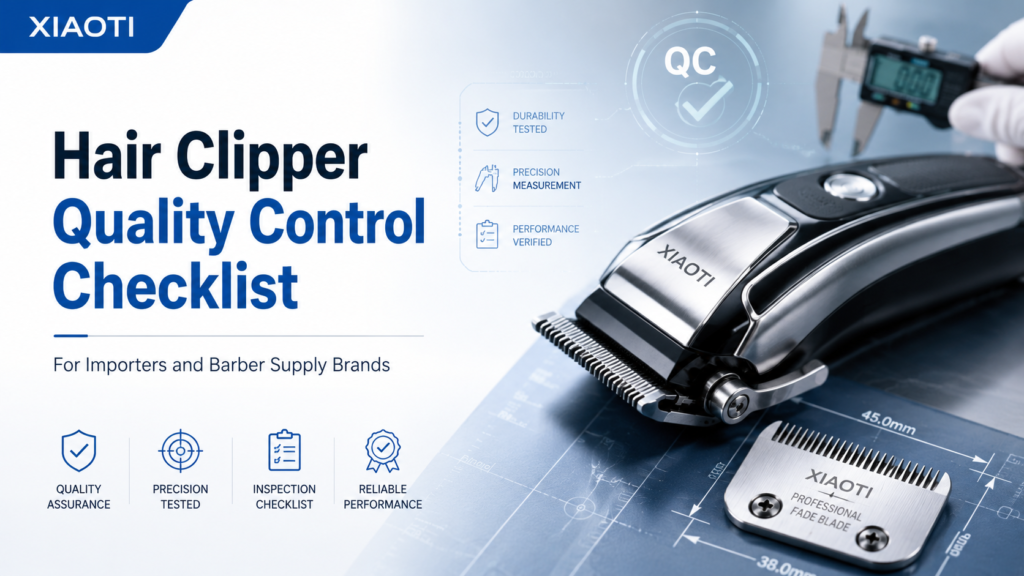
Hair Clipper Quality Control Checklist
| QC Stage | What to Check | Why It Matters | Questions to Ask the Supplier |
|---|---|---|---|
| Incoming Material Inspection | Motors, blades, batteries, PCB boards, charging ports, switches, housings, packaging materials | Unstable components lead to unstable finished products. Good QC starts before assembly. | Do you inspect key components before production? Can you show IQC records? |
| Motor Performance Testing | Speed stability, torque under load, noise, vibration, heat, motor lifespan | A professional clipper must keep stable power through different hair types and long working hours. | Do you test motor performance under load, or only when the clipper runs idle? |
| Blade Sharpness & Matching | Blade sharpness, alignment, spring pressure, zero-gap adjustment, cutting smoothness, coating quality | Blade performance directly affects cutting comfort, pulling risk, heat, and barber experience. | How do you check blade matching between the moving blade and fixed blade? |
| Battery & PCB Aging Test | Battery capacity, runtime, charging cycle, overcharge protection, discharge stability, PCB protection | Many complaints come from weak power, charging failure, or battery problems after several weeks of use. | Do you run battery and PCB aging tests before shipment? |
| Assembly Line Inspection | Blade installation, motor alignment, housing fit, button feel, charging port position, screw tightness, oil/grease application | In-process checks catch problems before the full batch is completed. | Do you inspect products during assembly or only at final inspection? |
| Noise & Vibration Check | Idle noise, cutting noise, vibration level, abnormal sound | High vibration or noise affects barber comfort and gives users a poor quality impression. | Do you have a standard for acceptable noise and vibration? |
| Charging Function Test | Charging response, indicator light, charging current, full-charge cutoff, abnormal heat | Charging issues are common after-sales problems in cordless clippers. | Is every unit tested for charging before packing? |
| Final Function Test | Power on/off, blade movement, cutting test, motor response, indicator lights | Final function testing helps prevent defective units from reaching customers. | Do you test every unit before packing or only random samples? |
| Packaging & Accessories Check | Logo, box, manual, labels, guards, brush, oil bottle, charger, blade cover | Missing accessories or wrong packaging can damage brand image even if the clipper works well. | Do you check packaging and accessories before shipment? |
| Pre-Shipment Inspection | Appearance, function, charging, cutting, packaging, carton condition, quantity check | This is the final protection before products leave the factory. | Can you provide a final inspection report before shipment? |
Why One Good Sample Is Not Enough
One perfect sample can show what a supplier is capable of preparing, but it does not prove that the supplier can control mass production.
For barber supply brands, the real question is not whether one sample looks good. The real question is whether the factory can deliver the same quality across 500, 2,000, or 10,000 units.
A reliable manufacturer should be able to explain how it controls quality during each production stage, not only how it prepares samples.
What Buyers Should Pay Special Attention To
For professional hair clippers, the most important quality risks usually come from inside the product:
- Motor and blade matching
- Battery and PCB reliability
- Blade sharpness and heat control
- Charging stability
- Noise and vibration
- Assembly consistency
- Packaging accuracy
If a supplier only says “quality is good” but cannot explain the testing process, buyers should be careful before moving to mass production.
How XIAOTI Controls Hair Clipper Quality
XIAOTI focuses on practical quality control for professional hair clippers, trimmers, clipper blades, and foil shavers.
Our process covers incoming material inspection, motor and blade matching, charging function testing, noise and vibration checks, assembly-line inspection, and final inspection before shipment.
For barber supply brands and private-label buyers, our goal is not only to make one good sample. We focus on stable mass production, repeat-order quality, and long-term product reliability.
Looking for a Hair Clipper Manufacturer with Practical Quality Control?
Contact XIAOTI to discuss OEM/ODM hair clippers, trimmers, clipper blades, foil shavers, ready-mold models, and private-label barber tool projects.
Website: https://xiaoticlipper.com/