Factory vs. Trading Company: What Really Matters to Overseas Buyers?
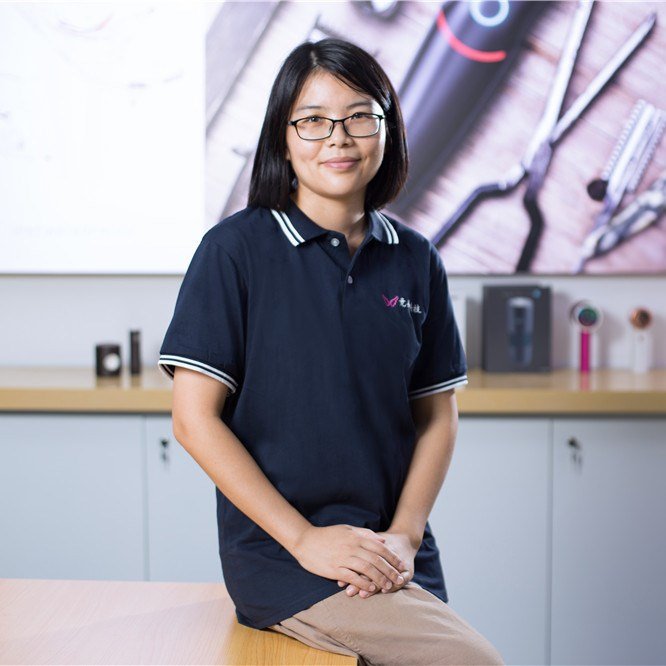
Factory vs. Trading Company: What Really Matters to Overseas Buyers? When sourcing professional hair clippers or trimmers from China, buyers often face a familiar question: Should I work directly with a factory or with a trading company? There is no simple answer. A factory may offer stronger manufacturing knowledge and more direct access to engineering. A good trading company may provide excellent communication, sourcing experience and market understanding. After working in the grooming industry and communicating with overseas customers for many years, I have come to believe that the more important question is not simply whether a supplier is a factory or a trading company. It is whether the supplier can connect manufacturing, product understanding and customer needs effectively. Factories and Trading Companies Are Built Differently Factories naturally spend a large part of their energy on manufacturing. There are production schedules to manage, materials to control, workers and production lines to coordinate, quality problems to solve, machines to maintain and new products to develop. For a professional hair clipper or trimmer, the work behind the product goes much deeper than its appearance. Blade alignment, zero-gap performance, blade carrier structure, motor torque, vibration, noise, battery performance, housing tolerances and long-term durability can all affect how the product performs in a barber’s hand. These are areas where direct manufacturing experience becomes valuable. Trading companies traditionally operate from a different perspective. Their work is more focused on finding products, communicating with customers, coordinating suppliers and responding to changing market requirements. Because of this,
Performance vs. Design: What Matters More in a Professional Hair Clipper?
Performance vs. Design: What Matters More in a Professional Hair Clipper? Recently, I had an interesting discussion with one of our customers about professional hair clippers. He asked me a simple question: when developing a professional clipper, which is more important, performance or appearance? My first reaction was that performance should definitely come first, especially for a professional tool used by barbers every day. However, after thinking about it from the product development side, I realized that the answer is actually not that simple, because a good clipper is never only about motor power, blade sharpness or how attractive the housing looks. It is a combination of many factors that need to work together inside a very limited space. A professional clipper is a small handheld tool, but inside the housing we need to arrange the motor, battery, PCB, blade drive system, switch, charging structure and many other components. At the same time, the product also needs to have enough power, good heat control, low vibration, reasonable weight, comfortable grip and a design that can represent the brand. When all these requirements are put together, the real difficulty is not making one specification look impressive, but finding the right balance between all of them. Performance Is Not Just About RPM When customers discuss clipper performance with us, the motor is usually one of the first topics. Many people pay attention to RPM, torque or whether the machine uses a brushless motor, and these are certainly important, but in my experience,
Hair Clipper Quality Control Checklist for Importers and Barber Supply Brands
A good sample does not always mean stable mass production. For professional hair clippers, many quality problems only appear after repeated use in a real barbershop. A clipper may look good during the first test, but later develop weak cutting power, blade pulling, charging failure, excessive noise, vibration, or unstable battery performance. That is why importers, barber supply brands, and private-label buyers should not judge a supplier only by product appearance or one perfect sample. A reliable hair clipper manufacturer should have a practical quality control process covering materials, motor, blade, battery, PCB, assembly, final inspection, and packaging. The checklist below can help buyers evaluate whether a supplier is ready for stable mass production. Hair Clipper Quality Control Checklist QC Stage What to Check Why It Matters Questions to Ask the Supplier Incoming Material Inspection Motors, blades, batteries, PCB boards, charging ports, switches, housings, packaging materials Unstable components lead to unstable finished products. Good QC starts before assembly. Do you inspect key components before production? Can you show IQC records? Motor Performance Testing Speed stability, torque under load, noise, vibration, heat, motor lifespan A professional clipper must keep stable power through different hair types and long working hours. Do you test motor performance under load, or only when the clipper runs idle? Blade Sharpness & Matching Blade sharpness, alignment, spring pressure, zero-gap adjustment, cutting smoothness, coating quality Blade performance directly affects cutting comfort, pulling risk, heat, and barber experience. How do you check blade matching between the moving blade and
How to Choose a Hair Clipper Manufacturer in China (2026 Guide)
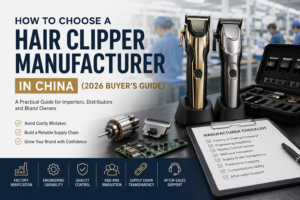
Looking for a reliable hair clipper manufacturer in China? Learn how to evaluate factories, compare OEM suppliers, verify engineering capability, and avoid costly sourcing mistakes. One importer from Europe once told me, “We’ve already changed suppliers three times in two years, but we’re still struggling with warranty issues.” Ironically, every supplier claimed they were a professional manufacturer. I’d like to say yes a true manufacturer is important for your product and brand development, but still there are many difference between factories. Introduction: The Hair Clipper Manufacturing Paradox For over two decades, China has been the undisputed heart of the global hair clipper industry. From high-end professional tools used in New York barbershops to affordable home grooming kits in European supermarkets, there is a 90% chance the device was born in a Chinese factory. However, as we move into 2026, the landscape has shifted. The “Copy-Paste” era is over. Today’s market demands high-torque brushless motors, 4-hour battery life, DLC (Diamond-Like Carbon) coated blades, and ergonomic designs that prevent carpal tunnel syndrome. If you search for “Hair clipper manufacturer China” on any B2B platform, you will be hit with over 5,000 results. But here is the industry secret: Less than 5% of these “suppliers” are actual professional hair clipper factories with independent R&D capabilities. Most are trading companies or general electronics assemblers who treat hair clippers like just another plastic gadget. Choosing the wrong partner doesn’t just mean losing money; it means high warranty return rates, negative Amazon reviews, and permanent damage
15 traps that probably hide behind the pricing in hair straightener importing
When you purchase hair straighteners from China. You finally narrowed your lists of hair straightener manufacturers, at least you need to compare them from quality/service/price among them to choose the one that is standing out. Quality- you or your engineer can compare from the samples, and service- you must be very professional to tell by feeling the attitude of the salesman by chatting. But how about the price? You may take it as the simplest one as data can tell easily from the number of prices. But is that really so simple? A professional buyer in the hair straightener industry must have experienced this, 4 or 5 quotation sheets from different Chinese hair straightener manufacturers, the details are different. It is certain that in each quotation there are product pictures, price, MOQ, lead time, terms of payment, but if looking down to the quotation sheet carefully, you may find that specifications, standards of QC, artworks, packaging there would be big differences and some of them just skipped this content. But these things hidden may matter much for your product even your brand or easily fall yourself into a trap in purchasing hair straighteners from your manufacturer. 1.Plate Mainly there are ceramic plates, aluminum plates, or titanium plates, the price may differ for purchasing. And the color is also the art you must concern about. For more information for plates, you can see: https://xiaoticlipper.com/hair-straightener-plates/ 2. Housing Material There are mainly ABS/Nylon/PET for choice, the cost is different, and for a hair
The differences between hair straightener or curling iron heating elements
We know that mostly there are two kinds of heater or heating elements for hair straighteners/curling irons: PTC or MCH. What are the differences? What is the time for temperature warming up using PTC, MCH? For PTC, the highest temperature for it would be 290 Celsius degree but need 150 seconds to heat up to 230 Celsius degree and that’s the most brand name’s hair straighteners status. We could improve the time to 120 seconds. For MCH, the highest temperature can reach 800 Celsius degree. So it needs strict control for the PCB, once lost control, the heater will be too hot and cause danger! That’s why 90% of hair straighteners are using PTC. And the time needs 30 seconds to reach 230 Celsius degree. There’s a new heater from Japan. It can reach 230 Celsius degree in 10-12 seconds. Which applied in big brands like GHD.