

Factory vs. Trading Company: What Really Matters to Overseas Buyers?
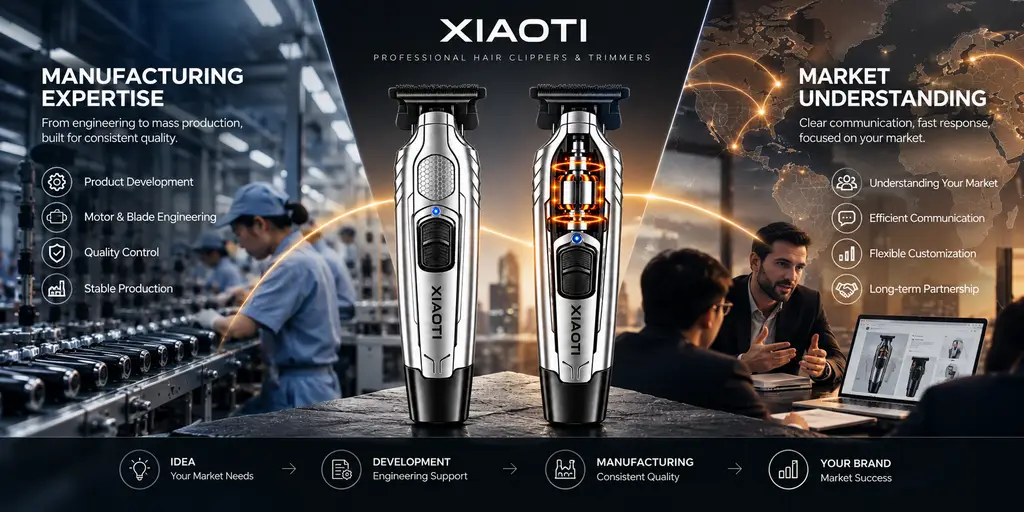
When sourcing professional hair clippers or trimmers from China, buyers often face a familiar question:
Should I work directly with a factory or with a trading company?
There is no simple answer.
A factory may offer stronger manufacturing knowledge and more direct access to engineering. A good trading company may provide excellent communication, sourcing experience and market understanding.
After working in the grooming industry and communicating with overseas customers for many years, I have come to believe that the more important question is not simply whether a supplier is a factory or a trading company.
It is whether the supplier can connect manufacturing, product understanding and customer needs effectively.
Factories and Trading Companies Are Built Differently
Factories naturally spend a large part of their energy on manufacturing.
There are production schedules to manage, materials to control, workers and production lines to coordinate, quality problems to solve, machines to maintain and new products to develop.
For a professional hair clipper or trimmer, the work behind the product goes much deeper than its appearance.
Blade alignment, zero-gap performance, blade carrier structure, motor torque, vibration, noise, battery performance, housing tolerances and long-term durability can all affect how the product performs in a barber’s hand.
These are areas where direct manufacturing experience becomes valuable.
Trading companies traditionally operate from a different perspective. Their work is more focused on finding products, communicating with customers, coordinating suppliers and responding to changing market requirements.
Because of this, many experienced trading companies are very good at understanding the commercial side of international business.
Neither capability should be underestimated.
What Buyers See Before They See the Factory
There is another change happening in our industry.
Years ago, buyers might meet suppliers mainly through exhibitions, sourcing agents or factory visits.
Today, the first meeting often happens online.
A buyer may discover a supplier through Google, Alibaba, LinkedIn, Instagram, YouTube or increasingly through AI search.
Before visiting a production line, the buyer has already seen the company’s website, product photos, technical information, videos and perhaps exchanged several emails or messages with its sales team.
This means that manufacturing capability alone is no longer enough.
A factory may have good engineers and stable production, but if it cannot clearly explain its products, respond efficiently or show buyers how its manufacturing process works, much of that capability remains invisible.
For overseas buyers, especially when working across thousands of kilometers, communication is part of the product experience.
But Professional Presentation Is Only the Beginning
The opposite is also true.
A professional website, good photography and fast communication can create a strong first impression, but they cannot replace product knowledge and manufacturing capability.
This becomes obvious once an OEM or ODM project moves beyond choosing a color and adding a logo.
For example, a professional barber brand may ask for stronger torque, a different blade combination, better zero-gap adjustment, lower vibration, longer runtime or changes to the housing structure.
A seemingly small request can affect several parts of the product.
Increasing motor performance may influence vibration, noise, battery consumption and heat. Changing the blade position may affect cutting performance, safety and assembly tolerance.
At this stage, the supplier needs more than good sales skills.
The sales team needs to understand the product well enough to communicate the requirement accurately, and the engineering and production teams need to be involved quickly when necessary.
That connection becomes especially important when developing products for professional users.
So What Should Overseas Buyers Actually Look For?
I would not choose a supplier simply because it says “We are a factory.”
Being a factory is important, but it is not automatically a guarantee of a successful cooperation.
Instead, I would look at several things together.
Can the supplier explain the product beyond the specifications in a catalogue?
Can they discuss the blade, motor, battery and mechanical structure when necessary?
Can their salespeople communicate directly with engineers?
Can they show how products are assembled, tested and inspected?
When market feedback comes back after launch, can they understand the problem and trace it to the product or manufacturing process?
And just as importantly, can they communicate clearly and respond efficiently throughout the project?
For a long-term OEM/ODM relationship, these capabilities are closely connected.
From Manufacturing Products to Supporting Brands
This is also something we have been working on at XIAOTI.
Our foundation is manufacturing. XIAOTI focuses on professional hair clippers and trimmers, with product development, customization and production built around real working conditions. XiaoTi Catalogue Booklet 2026-J…
But over time, we have realized that being able to manufacture a good product is only one part of supporting an overseas brand.
A customer does not simply need a factory to produce what is written on a purchase order.
Sometimes they need to understand why one blade structure behaves differently from another. Sometimes they need to evaluate whether a requested motor, battery or housing change is practical. Sometimes market feedback requires the product to be refined after the first production run.
That requires communication between the customer, sales team, engineering team and production team.
Our goal is therefore not to become a trading company.
It is to make our manufacturing capability easier for overseas customers to access and understand.
If we improve a blade or motor structure, we should be able to explain why it matters.
If we perform durability or quality testing, customers should understand what is being tested.
If an OEM customer wants to develop something different for their market, the requirement should reach the people who actually develop and manufacture the product without unnecessary layers in between.
That is how we believe a modern manufacturer should work.
Factory or Trading Company? Maybe That Is No Longer the Most Important Question
There are excellent factories and excellent trading companies, and both can create value for buyers.
The label itself does not tell the whole story.
For professional grooming products, what matters more is whether the supplier can combine product knowledge, manufacturing control, engineering support and good communication.
A strong supplier should understand what happens inside the factory.
But it should also understand what happens after the product leaves the factory — when it reaches a distributor, a barber shop and eventually the person holding the clipper every day.
For us at XIAOTI, that connection between market feedback and manufacturing is becoming increasingly important.
Because ultimately, overseas brands are not simply buying hair clippers.
They are choosing the team behind the product.