

Performance vs. Design: What Matters More in a Professional Hair Clipper?
Recently, I had an interesting discussion with one of our customers about professional hair clippers. He asked me a simple question: when developing a professional clipper, which is more important, performance or appearance?
My first reaction was that performance should definitely come first, especially for a professional tool used by barbers every day. However, after thinking about it from the product development side, I realized that the answer is actually not that simple, because a good clipper is never only about motor power, blade sharpness or how attractive the housing looks. It is a combination of many factors that need to work together inside a very limited space.
A professional clipper is a small handheld tool, but inside the housing we need to arrange the motor, battery, PCB, blade drive system, switch, charging structure and many other components. At the same time, the product also needs to have enough power, good heat control, low vibration, reasonable weight, comfortable grip and a design that can represent the brand. When all these requirements are put together, the real difficulty is not making one specification look impressive, but finding the right balance between all of them.
Performance Is Not Just About RPM
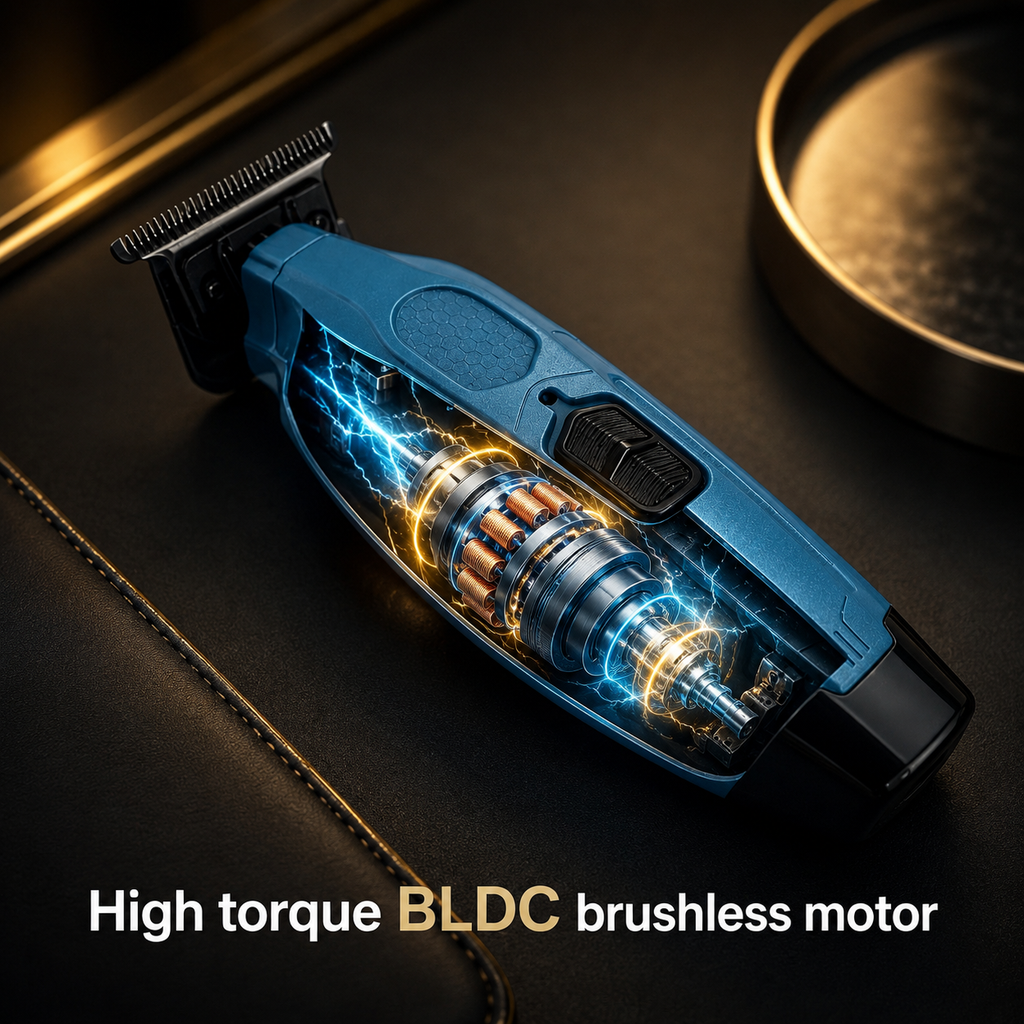
When customers discuss clipper performance with us, the motor is usually one of the first topics. Many people pay attention to RPM, torque or whether the machine uses a brushless motor, and these are certainly important, but in my experience, motor specifications alone do not tell you whether a clipper will actually perform well.
What matters more is how the machine behaves during real cutting. When it meets thick or dense hair, can the motor maintain stable power? Does the blade continue moving smoothly? Will the temperature rise too quickly after longer use? Is the vibration acceptable for a barber who may hold the clipper for many hours every day?
A stronger motor can improve cutting performance, but it may also bring more vibration, noise or heat if the internal structure is not properly designed. This is why, when we develop a professional clipper, we normally look at the motor, blade, blade carrier and transmission structure as one system instead of treating each component separately.
The same applies to the blade. Customers often ask about DLC blades, graphene blades, blade hardness or cutting angle, but the material itself is only one part of the final result. The fixed blade, moving blade, spring pressure, blade carrier and motor drive all need to match each other. If one part is not properly balanced, the clipper may still have problems such as pulling hair, excessive noise, blade heating or unstable cutting.
Longer Runtime Can Also Create New Problems
Battery runtime is another specification that looks very simple from the outside, but it often creates a lot of discussion during development.
Naturally, brands want longer working time because it is attractive to both barbers and end users. Four hours of runtime sounds better than two hours, and from a marketing point of view it is easy to understand why customers want to increase the battery capacity as much as possible.
However, a larger battery also means more weight and more space inside the housing. Since a clipper is a handheld tool, this can directly affect the balance and comfort of the machine. A specification may look excellent on the packaging, but if the clipper becomes too heavy or the center of gravity is uncomfortable, a professional barber may not enjoy using it for long periods.
For this reason, I think the better question is not always how large a battery we can put into the product, but how much runtime is actually needed while still keeping the machine comfortable, balanced and reliable.
A Good Appearance Also Has to Work With the Structure
Appearance has become more and more important in the professional barber market. There are already many clippers with similar basic functions, so brands naturally want their products to have a recognizable design and stronger visual identity.
We often receive very attractive renderings from customers, and sometimes the design looks perfect on the screen. Once our engineers start reviewing the structure, however, we may find that the external shape creates some limitations inside. The battery may no longer fit in the expected position, the motor may need to move, the grip area may become too wide, or the internal support structure may become more complicated.
This does not mean the design is wrong. It simply means that industrial design and engineering cannot really be separated when developing a professional handheld tool.
Even a small change to the housing can affect several parts of the machine. If we make the body thinner, we may need to reconsider the internal support structure. If we use a larger motor, the battery position may need to change. If the customer wants a different shape around the blade area, the taper lever or blade drive structure may also need to be adjusted.
This is something that is difficult to see from a rendering alone, and it is also one of the reasons why some OEM and ODM projects become more complicated after engineering evaluation.
So Which One Is More Important?
If I had to choose between performance and appearance, I would still say that performance is the foundation of a professional hair clipper. A beautiful product can attract attention quickly, especially on social media or on a retail shelf, but professional barbers will judge the machine by how it performs in actual use.
If the clipper pulls hair, becomes too hot, vibrates too much or loses power under load, the appearance will not be enough to make the user continue using it.
At the same time, I also do not think that performance alone is enough in today’s market. A professional product should perform well, but it should also feel comfortable in the hand, have reasonable weight and balance, and give the brand its own identity.
For me, this is probably the most difficult part of developing a good hair clipper or trimmer. It is not about making every specification as high as possible, but about deciding how the motor, battery, blade, structure, ergonomics and appearance can work together as one complete product.
This Is Also an Important Part of OEM/ODM Development
When we work with customers on OEM or ODM projects, different customers usually start from very different points. Some already have a complete industrial design, some have only a rendering, while others may only have a general idea about the type of barber they want to target and the level of performance they expect.
At this stage, our job is not simply to say yes to every request. Sometimes we also need to explain what may happen when one specification is changed, because increasing motor power, enlarging the battery or changing the housing shape may affect other parts of the machine.
These discussions may take more time at the beginning, but in my opinion they are very important. Many product problems can be avoided if the structure, performance and appearance are considered together before tooling and mass production start.
At XIAOTI, this is also how we look at professional clipper and trimmer development. We do not only focus on how the product looks or on one impressive specification; we are more interested in whether the complete machine works well as a professional tool.
A good-looking clipper may attract someone to pick it up for the first time, but whether they continue using it depends much more on what is happening inside the machine.
And that, in my opinion, is where the real difficulty—and also the interesting part—of developing a professional hair clipper begins.